
Philippines Prioritizes OECD Global Minimum Tax as a Strategic Revenue and Investment Reform
ACGlobal to Engage OECD Officials in Paris as Government Accelerates Adoption of Global Minimum Tax
PARIS, FRANCE — June 2026 — As governments worldwide implement the most significant international tax reform in a generation, the Philippines is accelerating efforts to adopt the OECD Global Minimum Tax (GMT), a landmark measure expected to strengthen revenue mobilization, enhance tax fairness, and reinforce investor confidence.
As part of the 2026 Philippine Investment Mission in Europe, global tax policy expert Mon Abrea, Chief Tax Advisor of Asian Consulting Group (ACGlobal), will lead a series of high-level engagements at the headquarters of the Organisation for Economic Cooperation and Development (OECD) in Paris, including discussions with John Peterson, Head of Division for Cross-Border and International Taxation (CBI) within the OECD’s Centre for Tax Policy and Administration (CTPA), and members of the OECD’s international tax team responsible for advancing the implementation of the Global Minimum Tax (Pillar Two) framework worldwide.
Peterson oversees the OECD teams responsible for the Taxation of the Digital Economy, the Global Minimum Tax, and the Forum on Harmful Tax Practices, playing a central role in shaping internationally coordinated tax frameworks and driving consensus among jurisdictions around the world.
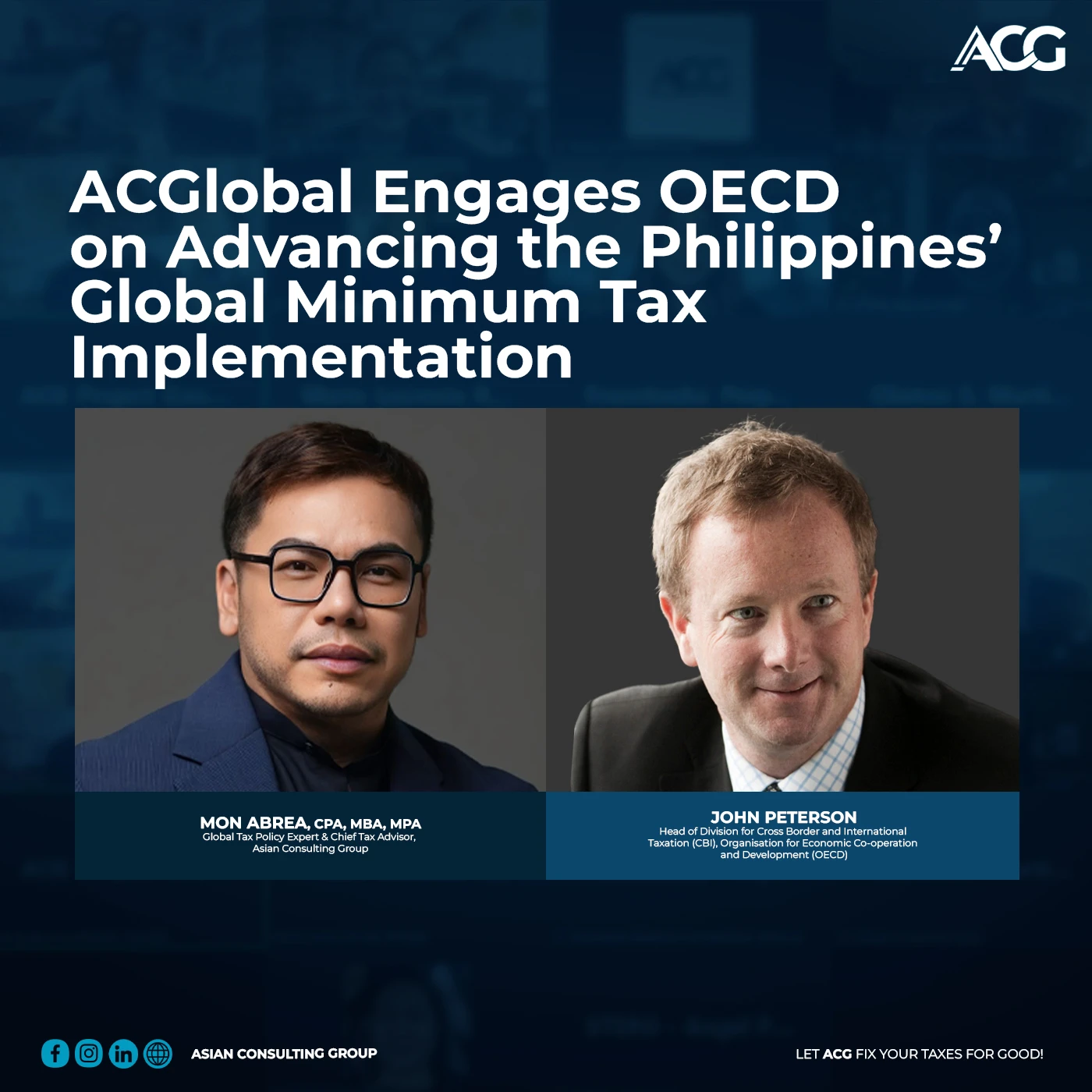
The Paris engagement reflects a long-standing collaboration between Abrea and OECD officials on international tax policy. While pursuing his Master’s in Public Administration at Harvard Kennedy School, Abrea began engaging with OECD experts on the future of international taxation and the challenges facing developing economies in an increasingly digital and globalized world.
One of his earliest public discussions on the subject was a series of policy interviews and podcast conversations with Peterson, where they explored the implications of emerging international tax reforms for developing countries, including the Philippines.
Even before the Philippines formally joined the OECD/G20 Inclusive Framework, Abrea had been actively advocating for the country’s participation and eventual adoption of the Global Minimum Tax. Through policy papers, international conferences, investor briefings, media engagements, legislative discussions, and consultations with government officials, he consistently argued that the Philippines must secure its fair share of tax revenues from large multinational corporations and digital companies generating billions of pesos in revenues from the Philippine market.
“For years, I have advocated that the Philippines should not be left behind in the global tax conversation,” Abrea said. “The Global Minimum Tax is fundamentally about fairness. If multinational enterprises generate substantial economic value from Filipino consumers, workers, and markets, then a reasonable share of those profits should contribute to national development.”
The engagement follows a strategic policy meeting between the Department of Finance (DOF), led by Finance Secretary Frederick Go, and the ACGlobal Board of Directors, including former Trade Secretary Ramon Lopez, where the OECD Global Minimum Tax emerged as one of the government’s priority fiscal reforms.
During the meeting, Secretary Go confirmed that the DOF will prioritize the enactment of the OECD Global Minimum Tax as part of the administration’s broader economic modernization agenda.
The OECD Global Minimum Tax establishes a 15% minimum effective tax rate on large multinational enterprises with annual revenues exceeding €750 million. Developed through unprecedented international cooperation among more than 140 jurisdictions, the framework seeks to ensure that multinational corporations pay a fair share of tax where economic activity occurs and value is created.
According to estimates presented during the discussions, the Philippines could generate up to ₱100 billion in additional revenues within the first two years of implementation. ACGlobal’s policy analysis further indicates that delays in adopting the reform have already resulted in substantial foregone revenues as neighboring jurisdictions moved ahead with implementation.
“The Global Minimum Tax is one of the most important revenue reforms available to the Philippines today,” Abrea said.
“It is not about imposing additional taxes on ordinary Filipinos. It is about ensuring that large multinational corporations pay their fair share where they generate substantial economic value. In an increasingly digital and borderless economy, countries must protect their tax base while remaining competitive and attractive to investors.”
The Paris discussions will focus on implementation strategies, international best practices, investment implications, and opportunities for the Philippines to align its tax system with evolving global standards. The engagement also aims to strengthen collaboration between Philippine policymakers and OECD experts as the country prepares for adoption.
For investors, the reform provides greater policy certainty and aligns the Philippines with internationally accepted tax standards. For government, it creates a sustainable source of revenue without increasing the tax burden on Filipino workers, consumers, MSMEs, and domestic businesses.
Additional revenues generated from the Global Minimum Tax could help finance strategic priorities such as infrastructure modernization, education, healthcare, digital transformation, climate resilience, and social protection programs.
As global tax rules continue to evolve, the Philippines now faces a historic opportunity to protect its tax base, strengthen fiscal sustainability, and ensure that globalization works not only for multinational corporations but also for the Filipino people.
“The world is changing, and global tax rules are changing with it,” Abrea said. “The Philippines must seize this opportunity to strengthen revenue integrity, improve competitiveness, and build a more resilient economy for future generations.”
About ACGlobal
ACGlobal is an international tax advisory and investment consulting firm serving multinational corporations, investors, business organizations, and government stakeholders across Asia-Pacific, Europe, North America, and the Middle East. The firm provides expertise in tax policy, investment strategy, regulatory compliance, and economic reform.
Media and Partnership Inquiries
Hazel Joy Mendoza, MBA
Chief Strategy Officer, ACGlobal
hazel@acg.ph
The Philippines Rises. The World Invests. Let’s MAKE IT HAPPEN IN THE PHILIPPINES

Asian Consulting Group
Ready to Take the Next Step?
uniting global leaders, investors, and policymakers.